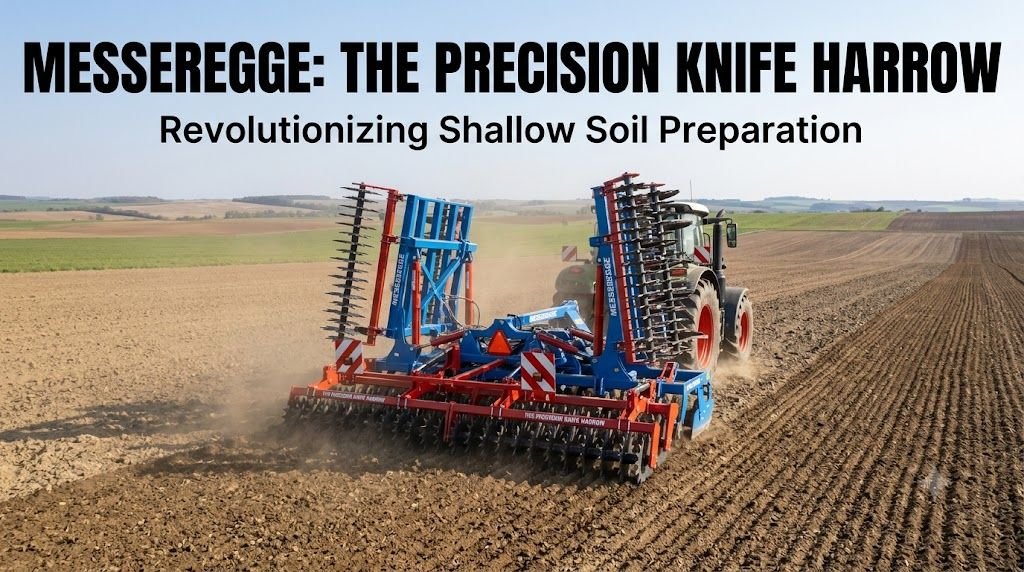
In the world of modern agriculture, efficiency and precision are paramount. Farmers constantly seek tools that minimize soil disturbance while maximizing seedbed quality. Enter the messeregge—a term that translates from German as “knife harrow” or “blade harrow.” This precision agricultural implement is designed specifically for shallow soil preparation, offering a unique blend of cutting action and minimal inversion. Unlike traditional harrows that may drag or clod, the messeregge uses sharp, vertical blades to slice through residue and thin crusts, creating an ideal environment for germination. In this article, we will explore what makes the messeregge stand out, its applications, and why it is becoming a go-to tool for conservation-minded growers.
Understanding the Messeregge: More Than Just a Harrow
At its core, a messeregge is a specialized harrow equipped with a series of knife-like blades mounted on a frame. These blades operate at shallow depths—typically between 2 and 5 centimeters—making the tool perfect for post-harvest stubble management, light incorporation of cover crops, and preparing a fine seedbed without burying valuable organic matter. The term “knife harrow” perfectly describes its action: each blade cuts through the soil like a knife rather than tilling it deeply. This precision allows farmers to address specific issues such as weed seedling control, crust breaking, and moisture conservation without disturbing beneficial soil structure. The messeregge is particularly valued in no-till and reduced-till systems where maintaining surface residue is critical.
Key Design Features of a Messeregge
To appreciate the messeregge, one must understand its construction. Usually consisting of a rigid or folding frame, the implement holds rows of spring-loaded or rigid blades. The spacing between blades can be adjusted to suit different crop residues and soil types. Some models feature individual blade suspension, which allows each knife to follow ground contours independently, ensuring uniform working depth across uneven fields. The blades themselves are often shaped like a narrow knife or a curved tine with a sharp leading edge, designed to slice through straw, corn stalks, or cover crop stems without dragging them. Because the messeregge works at such shallow depths, it requires less horsepower than a disc harrow or a deep tillage tool, translating to fuel savings and lower soil compaction risk.
Adjustability and Precision
Modern messeregges offer adjustable working depth and blade angle, giving the operator fine control over the aggressiveness of the operation. For example, a steeper blade angle can be used to create a more pronounced mixing effect, while a shallower angle simply slices surface crust. This flexibility makes the tool suitable for a wide range of tasks, from light weed control in fallow to preparing a smooth, level seedbed for spring cereals. Many farmers pair the messeregge with a roller or a cultipacker to further firm the soil after the blade pass, enhancing seed-to-soil contact.
Applications in Modern Agriculture
The messeregge excels in several key agricultural scenarios. First, it is an excellent tool for shallow incorporation of crop residues. By cutting residue into smaller pieces and mixing it slightly with the top layer of soil, the messeregge accelerates decomposition and helps suppress disease pressure. Second, it is highly effective for terminating cover crops like rye, vetch, or clover without resorting to herbicides. The knife action cuts the stems at the soil line, causing the cover crop to wilt and die, often with a single pass. Third, the messeregge is used for seedbed preparation just before planting. Its slicing action creates a friable, clod-free tilth that allows for uniform seed placement and rapid emergence.
Weed Control and Crust Breaking
In organic or low-herbicide systems, the messeregge serves as a mechanical weed control tool. The blades uproot tiny weed seedlings and disturb the uppermost soil layer, interrupting weed germination cycles. Additionally, after heavy rains, a surface crust can form that impedes water infiltration and seedling emergence. A quick pass with a messeregge breaks that crust without damaging deeper soil structure, restoring porosity and aeration. This dual-purpose functionality makes the implement a cost-effective addition to any farm’s toolkit.
Comparing the Messeregge to Other Harrows
It is helpful to contrast the messeregge with more common harrow types. A disc harrow uses concave discs that cut, turn, and mix the soil, often to depths of 10–15 cm. While effective for incorporating heavy residues, disc harrows can cause soil smearing and bury too much residue in conservation systems. A spring-tooth harrow, on the other hand, rips and shatters the soil using curved tines, but it may create larger clods and is less precise at shallow depths. The messeregge occupies a unique niche: it is shallower than a disc, more aggressive than a spike-tooth harrow, and more precise than a tine harrow. Its slicing action leaves residue on the surface—a crucial benefit for erosion control and moisture retention. For farmers moving toward regenerative practices, the messeregge offers an ideal middle ground between full tillage and zero-till.
Selecting the Right Messeregge for Your Farm
When choosing a messeregge, consider factors such as working width, blade type, and compatibility with your tractor’s hitch system. Smaller models of 3–6 meters are suitable for mid-sized operations, while large folding units can exceed 12 meters for broadacre farming. Blade options include straight, concave, or serrated knife blades; each behaves differently in various residue types. For example, serrated blades cut tougher stalks more effectively, whereas straight blades produce a cleaner cut in light residues. Also, evaluate whether the frame includes a leveling device or an integrated press wheel to improve seedbed smoothness. Because the messeregge is a precision tool, investing in one with depth control wheels will pay off in consistent results across variable soil conditions.
Maintenance and Best Practices
To keep your messeregge performing optimally, regularly inspect blade sharpness and straightness. Dull or bent blades will not cut cleanly, leading to residue dragging and uneven coverage. Depending on soil type and usage, blades may need replacement after 200–500 hectares. It is also important to check the frame for cracks and to lubricate pivot points on folding models. When operating, always work at a speed that allows proper slicing—typically 8–12 km/h. Going too fast can cause the blades to bounce, resulting in inconsistent depth. For best results, align the messeregge pass with the direction of previous crop rows to minimize residue blockage.
Conclusion: Why the Messeregge Deserves a Place in Your Tool Shed
The messeregge, or knife harrow, is a testament to how specialized tools can solve persistent challenges in agriculture. By focusing on shallow, precision soil preparation, it helps farmers reduce fuel costs, protect soil health, and achieve superior seedbeds without compromising residue cover. Whether you are managing organic fields, integrating cover crops, or simply looking for a more efficient way to prepare land for spring planting, the messeregge offers a practical, durable, and effective solution. As the demand for sustainable farming practices grows, this German-engineered implement is likely to become even more common in fields around the world. Embrace the messeregge—and give your soil the gentle, precise treatment it deserves.